



Watch Safes: Understanding the EN 1143-1 Standard

In summary
EN 1143-1 is the European anti-burglary reference standard for safes. It classifies safes from Grade 0 to Grade VI according to their resistance, measured in resistance units (RU). Each grade determines a maximum insurable amount, negotiated with your insurer.
For a valuable automatic watch collection, the minimum recommended grade is Grade I, and often Grade II or III once the value exceeds €50,000.
Safe certification isn't an administrative detail. It's what determines whether your insurer pays out, or not, in the event of a theft. For a luxury automatic watch collection, the question isn't whether certification is necessary, but which one.
This guide breaks down the EN 1143-1 standard in its current version (2019), the resistance grades, insurable amounts according to the ECB-S/VdS framework, and the two families of Mercier & Fils safes, certified models and showroom pieces, to help you choose with precision.
What is the EN 1143-1 standard?
The EN 1143-1 standard (NF EN 1143-1, current 2019 version) is the European standard that defines the testing and classification conditions for safes, strongrooms, and vault doors based on their burglary resistance. It is published by CEN (European Committee for Standardization) and transposed into French law by AFNOR.
The principle is simple: an accredited laboratory attacks the safe with an arsenal of standardized tools, drills, grinders, oxyacetylene torches, pry bars, for a defined period. The resulting score, expressed in resistance units (RU), determines the grade.
What the standard actually measures:
- Body resistance (walls, floor, ceiling)
- Door and hinge resistance
- Locking system resistance
- Resistance to combined mechanical and thermal attacks for higher grades
What it doesn't cover: fire resistance. That's addressed by other standards, EN 1047-1 for high protection, EN 15659 for light protection (LFS 30 / LFS 60).
The certification bodies recognized in Europe are mainly ECB-S (European Certification Board – Security) and VdS Schadenverhütung (Germany). Their certifications are equivalent and recognized by French insurers.
Key takeaway: a safe without EN 1143-1 or EN 14450 certification is not insurable beyond a few thousand euros. Regardless of its apparent build quality, insurers require proof of independent testing.
EN 1143-1 grades: complete table with insurable amounts
The table below reflects official ECB-S/VdS reference data under the EN 1143-1, EN 14450, and EN 15659 standards. Insurable amounts are indicative reference values; your insurance contract may set different limits, always check with your insurer.
| Level | Type | Standard | Resistance | Insurable (private use) | Insurable (commercial use) |
|---|---|---|---|---|---|
| S1 | Security Cabinet | EN 14450 | 40 TP / 2 SU | up to €5,000 | not insurable |
| S2 | Security Cabinet | EN 14450 | 60 TP / 5 SU | up to €20,000 | up to €2,500 |
| Grade 0 | Safe | EN 1143-1 | 30 RU | up to €40,000 | up to €10,000 |
| Grade I | Safe | EN 1143-1 | 30 / 50 RU | up to €65,000 | up to €20,000 |
| Grade II | Safe | EN 1143-1 | 50 / 80 RU | up to €100,000 | up to €50,000 |
| Grade III | Safe | EN 1143-1 | 80 / 120 RU | up to €200,000 | up to €100,000 |
| Grade IV | Safe | EN 1143-1 | 120 / 180 RU | up to €400,000 | up to €150,000 |
| Grade V | Safe | EN 1143-1 | 180 / 270 RU | negotiable, over €500,000 | up to €250,000 |
| D-I | Deposit Safe | EN 1143-2 | 30 / 50 RU | up to €65,000 | up to €20,000 |
| LFS 30 | Light Fire Protection | EN 15659 | 30 min / max 338°F interior, light fire protection (paper documents) | ||
| LFS 60 | Light Fire Protection | EN 15659 | 60 min / max 338°F interior, light fire protection (paper documents) | ||
How to read the table:
- RU (Resistance Units): the score achieved during the burglary test. The double value (e.g. 30/50 RU) corresponds to partial access / full access.
- TP / SU: test units specific to the EN 14450 standard (Tool Points / Security Units).
- LFS 30 / LFS 60: light fire protection under EN 15659, keeping the interior temperature below 338°F for 30 or 60 minutes. These levels are not burglary-resistance certifications.
- Insurable amounts are ECB-S/VdS reference values. Your insurer may apply different limits depending on your contract.
Why certification matters for an automatic watch collection
A manufacture watch, Patek Philippe, A. Lange & Söhne, F.P. Journe, can be worth anywhere from €20,000 to several hundred thousand euros. A five-piece collection easily exceeds €150,000. At that level, insurability is no longer a theoretical question.
Three concrete reasons EN 1143-1 certification is essential:
- Compensation depends on the grade. Without recognized certification, insurers cap compensation at a few thousand euros, regardless of the real value of the stolen watches. With a certified Grade III, the cap rises to €200,000 for private use.
- Insurers verify. In the event of a claim, the expert appointed by the insurance company systematically requests the safe's certificate of conformity. An uncertified safe, however massive, isn't enough.
- The risk is targeted. Luxury watches are known targets. Lightweight and quickly resold, they attract organized burglars equipped with professional tools. A safe certified EN 1143-1 Grade II or III resists these attacks; a decorative safe does not.
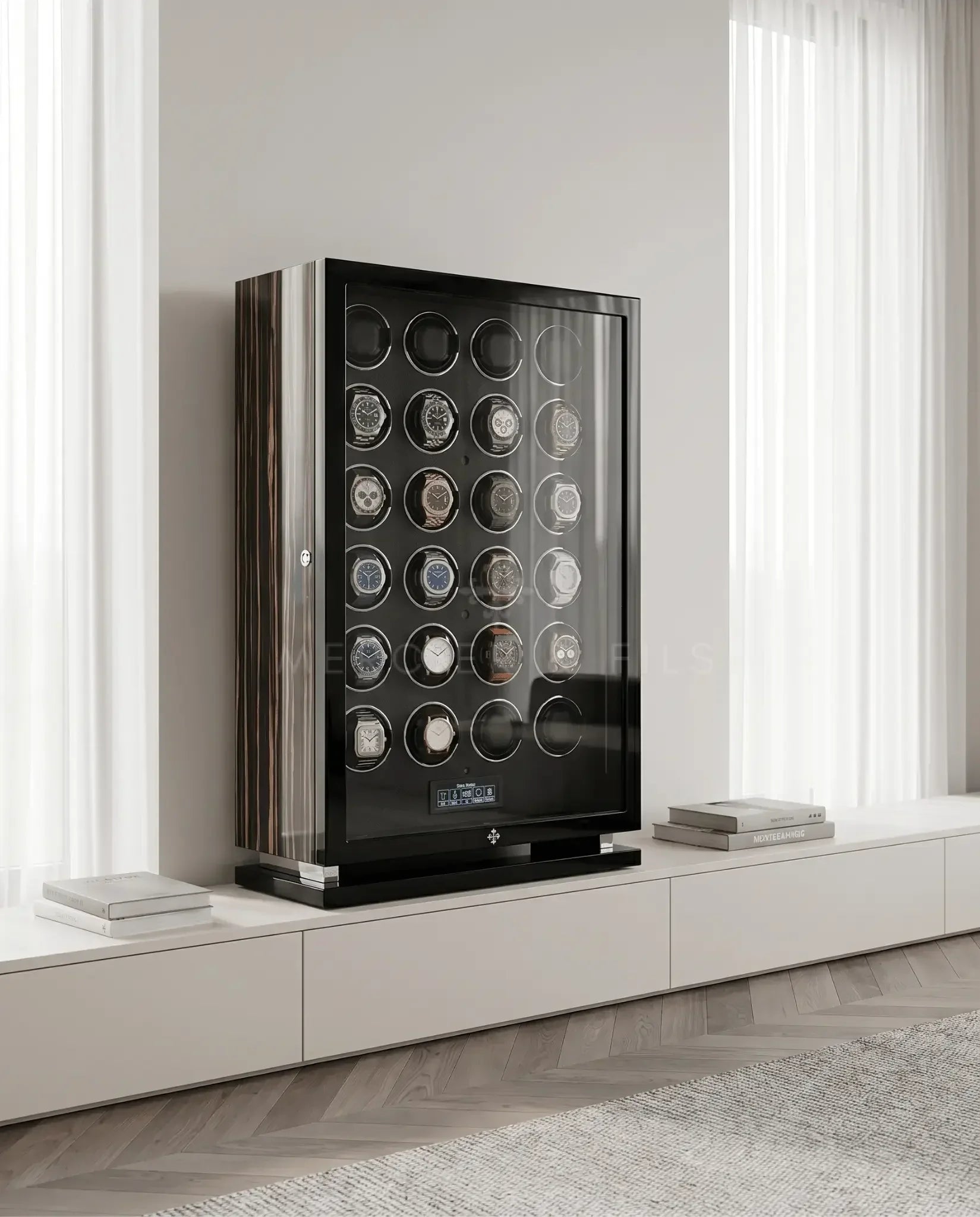
For collectors who also use a safe for automatic watches with a built-in winder, the outer safe's certification remains the first line of defense, the winder itself is not a security device.
Key takeaway: always check that your insurance contract explicitly covers collector watches and specifies the required safe grade. Some "valuables" contracts require a minimum Grade II starting at €50,000 in declared value.
Two families of Mercier & Fils safes
The Mercier & Fils range is divided into two distinct families, built to the same standards of materials and finish, but designed for different uses.
Showroom pieces, exceptional safes not certified to EN 1143-1
These safes are not subject to the EN 1143-1 certification process. Not by default of construction, but because their primary purpose is different: exceptional private collections, showrooms, high-end architectural integration. They are built to the same level of demand as our certified models, 304L stainless steel, BioLock® biometric lock, key lock, but do not carry ECB-S marking.
These pieces are not insurable under standard ECB-S scales. They are intended for collectors whose insurance coverage is negotiated individually, or whose primary use is displaying and showcasing the collection.
EN 1143-1 certified safes, Grade I to Grade V + LFS 30 / LFS 60
Mercier & Fils certified watch safes are tested and approved to the EN 1143-1 standard by the accredited body ECB-S. They cover the full range, from Grade I (€65,000 for private use) to Grade V (negotiable insured amount, typically over €500,000), with LFS 30 and LFS 60 fire protection options under EN 15659.
Two flagship examples of Mercier & Fils Grade V safes:
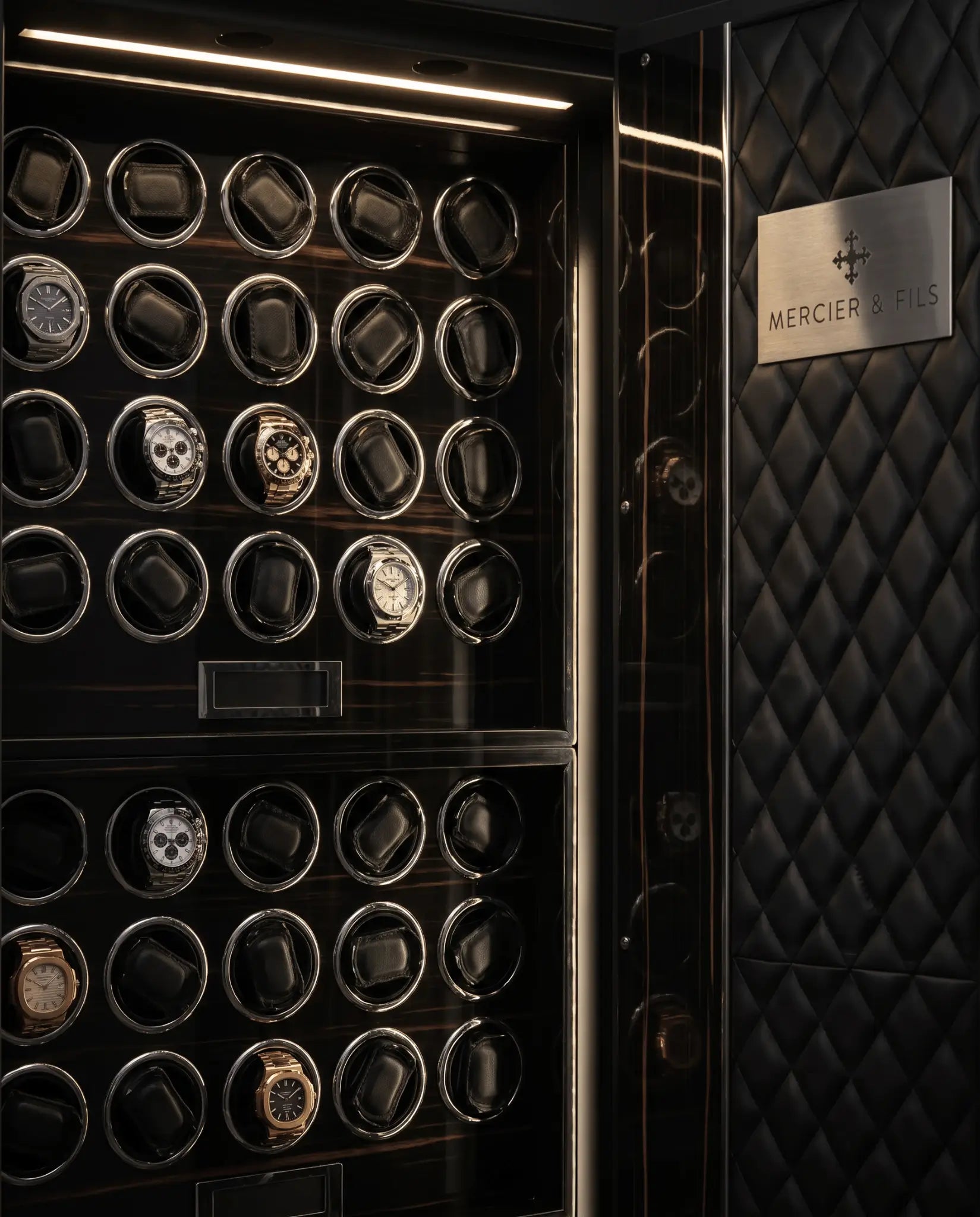
- Régent 4 (available from Grade I to V) — 26.8 × 26.8 × 24.8 in, weighing over 1,323 lbs, with a 6.5 in thick door and 2.8 in walls. A safe whose sheer weight alone constitutes a considerable physical deterrent.
- Régent 20 (available from Grade I to V) — 59.4 × 26.8 × 26.8 in, weighing over 2,535 lbs. Designed for large collections or private display spaces.
Installation note: before placing any safe, be sure to check the load-bearing capacity of the floor slab. A weight of several hundred pounds, or over a ton for the largest models, requires a prior structural assessment, coordinated with a structural engineer or your architect.
Standard equipment on all certified models:
- High-security key lock
- Digilock® EN 1300 Grade B PS610 electronic lock, the benchmark standard for certified electronic locks
The choice of grade depends directly on the value of your collection and your insurer's requirements. See the next section for the selection method.
Discover our safes for automatic watches
How to choose the right security level for your collection
The grade of an EN 1143-1 certified safe should be calibrated on three parameters: the total value of the collection, your insurer's requirements, and the installation environment.
Four-step method:
1. Assess the total value to protect. Have your collection appraised, resale values move quickly in the manufacture watch market. Use the replacement value, not the purchase price.
2. Consult your insurer before buying. Ask in writing for the minimum grade required for the amount to be covered and the installation conditions (anchoring, approved installer). Some insurers require Grade II starting at €50,000, others accept Grade I up to €65,000.
3. Plan for collection growth. A Grade II costs more than a Grade I, but it saves you from replacing the safe in three years. Always choose a grade slightly above your immediate needs.
4. Account for the environment.
- Upper-floor apartment with a standard slab: check the load capacity before choosing a heavy model.
- Standalone house: police response time is longer; go up one grade.
- Alarm connected to a monitoring service: may affect your insurance contract terms.
Practical benchmarks by collection value:
| Collection value | Recommended grade | Insurable amount (private) |
|---|---|---|
| Up to €40,000 | Grade 0 | €40,000 |
| €40,000 – €65,000 | Grade I | €65,000 |
| €65,000 – €100,000 | Grade II | €100,000 |
| €100,000 – €200,000 | Grade III | €200,000 |
| €200,000 – €400,000 | Grade IV | €400,000 |
| Over €400,000 | Grade V | Negotiable, over €500,000 |
For collections that also include sensitive documents, deeds, certificates of authenticity, insurance inventories, an LFS 30 or LFS 60 option under EN 15659 protects these paper documents against a light fire, keeping the interior temperature below 338°F.
For any questions about choosing the right model for your situation, our guide to automatic watch winders complements this approach, and our team remains available via the contact page for personalized advice.
Frequently Asked Questions
Is EN 1143-1 certification mandatory to insure a watch collection?
No, it isn't required by law. But in practice, nearly all insurers require recognized certification, EN 1143-1 or EN 14450, to cover valuables beyond a few thousand euros. Without certification, compensation is capped or denied. Check the general terms of your homeowner's policy or your "valuables" contract.
What's the difference between ECB-S and VdS certification?
None in substance. ECB-S (European Certification Board – Security) and VdS Schadenverhütung are two accredited bodies that apply exactly the same EN 1143-1 test protocols. A safe certified VdS Grade II is strictly equivalent to one certified ECB-S Grade II. French insurers recognize both.
Is an EN 1143-1 certified safe also fire-protected?
No. The EN 1143-1 standard covers burglary resistance only. Fire protection falls under other standards: EN 1047-1 for high protection (including a drop test), EN 15659 for light protection LFS 30 / LFS 60 (paper documents, max 338°F interior). Some safes combine both certifications, check the markings.
Do I need to declare my safe to my insurer?
Yes, always. Inform your insurer of the model, certification, location, and installation conditions. Keep the certificate of conformity, the purchase invoice, and, if applicable, proof of professional installation. These documents are required in the event of a claim.
Does my certified safe need to be anchored for the certification to be valid?
EN 1143-1 certification applies to the safe itself, not its installation. But your insurer may impose specific installation conditions, floor or wall anchoring, installation by an approved professional, for coverage to apply. Check before installing.
Is a safe weighing several hundred pounds safer than a certified Grade I safe?
Not necessarily in insurance terms. Weight is a genuine physical security factor, moving a safe weighing several hundred pounds requires heavy equipment, but it doesn't replace certification recognized by insurers. To be compensated, you need a certified grade. The two approaches are complementary, not interchangeable.
How long does EN 1143-1 certification remain valid?
Certification is granted to the model, not the individual unit. It remains valid as long as the manufacturer doesn't change the design and the certifying body doesn't withdraw it. In practice, a certified safe keeps its certification indefinitely, barring structural changes. Your insurer may still revise its insurable-amount scales independently of the certification.
Can I store certificates of authenticity and documents in an EN 1143-1 safe?
Yes, but without guaranteed thermal protection. To protect paper documents, certificates of authenticity, deeds, photo inventories, against fire, add an LFS 30 or LFS 60 option under EN 15659. These levels keep the interior temperature below 338°F for 30 or 60 minutes respectively.
Are there tax implications to declaring a safe?
The safe itself is personal property subject to standard tax rules. Its contents, watches, jewelry, cash, are subject to standard reporting obligations under French law (wealth tax for relevant assets, estate declarations, etc.). Owning a safe doesn't create a specific tax obligation, but its contents must be consistent with your asset declarations. When in doubt, consult your notary or tax advisor.
The tax, regulatory, and legal information mentioned in this FAQ is provided for informational purposes and reflects the state of French law as of the publication date. It does not replace advice from a qualified professional for your personal situation.
Sources
NF EN 1143-1 (2019) — AFNOR Éditions, official text of the standard in effect.
ECB-S — European Certification Board Security, the reference European certification body.
EN 15659 — light fire protection standard (LFS).
Fichet-Bauche — manufacturer reference on EN 1143-1 grades.
Cet article fait partie du Journal Mercier & Fils, guide de référence sur la conservation et le remontage des montres automatiques de collection. Pour toute question technique sur un calibre spécifique non documenté ici, l'équipe Mercier & Fils peut être contactée pour une vérification personnalisée.
Read more
Updated 9 September 2026.WOLF 1834 or Swiss Kubik: compare specific models rather than reputations. A preset winder and a programmable device provide different functions. This comparison covers set...
There's a widespread belief, even among seasoned collectors, that a watch winder wears out an automatic movement by keeping it artificially in motion. This idea deserves to be examined point by poi...
Leave a comment
All comments are moderated before being published.
This site is protected by hCaptcha and the hCaptcha Privacy Policy and Terms of Service apply.