


UL 687 and EN 1143-1 share a purpose: evaluating how a safe withstands a demanding physical attack. Our comparison focuses on three practical questions: which attack methods are considered, what resistance level is sought, and which surfaces are tested. Together, these give a useful way to place American ratings and European grades in context.
For an American buyer considering a European safe, a familiar TL reference can make a grade easier to understand. The strongest comparison explains where that reference comes from.
ECB•S, UL and TL: the vocabulary behind the ratings
Start by separating the standard, which sets requirements and test methods, the laboratory, which evaluates the product under test, and the certification body, which assesses the evidence and issues certification. A standard number, a resistance grade, and a certification mark answer different questions.
What does ECB•S mean?
ECB stands for European Certification Body. European Certification Body GmbH is a neutral product-certification body accredited to ISO/IEC 17065. ECB•S is its certification mark for security products. EN 1143-1 identifies the burglary-resistance standard; ECB•S identifies certification issued under the applicable framework.
The mark carries information identifying the certification and protection level. For a safe, read the standard, grade, and identification references together with the proposed model. This makes the stated performance traceable.
What does UL mean?
UL comes from the historic name Underwriters Laboratories. Today, UL Standards & Engagement develops standards, while UL Solutions provides services including testing and certification. For this comparison, UL 687 is the burglary-resistance standard and TL-15 or TL-30×6 are class designations.
How do you read TL-15, TL-30×6, TRTL and TXTL?
| Term | Meaning |
|---|---|
| TL | Tool-Resistant: resistance to attack using tools. |
| 15 / 30 | Net working time in minutes for the corresponding test. |
| ×6 | Testing extends to the door and body across all six sides. |
| TRTL | Torch- and Tool-Resistant: tools and thermal attack. |
| TXTL | Torch-, Explosive-, and Tool-Resistant: tools, thermal attack, and explosives. |
A TL-30×6 designation combines an attack-tool family, net working time, and test coverage. TRTL and TXTL broaden the threats addressed. The number alone does not describe the complete protection.
EN denotes a European standard. Grade I, II, or III identifies a resistance class within that framework. RU stands for Resistance Units, the units used in the European resistance assessment.
Our view: compare protection across the complete enclosure
In our reading of the test methods, UL classifications carrying the ×6 suffix are the most relevant American references when discussing protection of the complete enclosure. UL 687 distinguishes attacks involving the door and front face from those involving the door and body..
For an initial grade-by-grade reference, the following comparisons are published in J.SH’s manufacturer catalog. We use them as an industry classification guide, rather than results of cross-testing conducted by Mercier & Fils.
| European grade | Published U.S. reference | How to read it |
|---|---|---|
| EN 1143-1 · Grade 0 | TL-15 | The first reference in the cited classification guide. |
| EN 1143-1 · Grade I | TL-15×6 | The ×6 designation includes tests involving the door and body. |
| EN 1143-1 · Grade II | TL-30 | A higher-resistance reference in the guide; TL-30 has a frontal test scope. |
| EN 1143-1 · Grade III | TL-30×6 | A higher-resistance reference covering the door and body. |
Source: J.SH catalog, p. 16, a classification guide presented for the Israeli market. Indicative, non-contractual comparisons; they do not establish UL certification for a particular product or a formal standards conversion.
This guide helps place the terminology. For a specific project, we then consider the proposed construction, its certification, and the protection requirements.
Why published comparisons can differ
An industry classification chart and a manufacturer’s own product comparison serve different purposes. The first aligns categories; the second can describe how a particular product is positioned.
Dominator, for example, describes its FA TL-15 as comparable to Grade III and its FX TL-30×6 as comparable to Grade V, while also reporting a secondary VdS Class 3 certification for FX. These are the manufacturer’s statements, rather than findings from an independent product assessment by Mercier & Fils..
A grade or rating identifies a threshold achieved, not necessarily the product’s maximum resistance. A manufacturer can position a construction beyond its certification threshold. That helps explain why product comparisons can differ from a general classification chart.
Our preference is for a comparison with an explicit basis, rather than an isolated equality between two labels.
UL ratings combine active working time with test coverage
TL-15 and TL-30 refer to 15 and 30 minutes of net working time. This counts active tool contact rather than the full elapsed testing session..
The tool set also matters. American Security describes portable mechanical and electric tools for TL-15, with additional cutting tools and power saws for TL-30. Its description of the TL-15 entry criterion includes opening the door or producing an opening of at least 6 square inches..
The ×6 designation expands the timed test scope to all sides. A frontal TL-30 model still has applicable body-construction requirements; omitting ×6 does not mean its walls provide no protection.
European grades use weighted resistance measurements
European test reporting accounts for the tools and time involved in an attack. ECB•S guidance describes attack records and calculated resistance values, with distinct partial- and complete-access objectives..
Resistance Units, or RU, therefore express a result within a weighted test method. They should be understood through that method rather than treated as minutes with a different name.
A technical presentation hosted by Thailand’s standards institute, TISI, compares time-based and point-based systems, including their entry criteria..
How are Resistance Units assessed?
R08 describes reporting a tool’s basic value, coefficient, and measured time, followed by the calculated resistance value. RU therefore combines the means used with measured working time. Different tool categories can change the assessment even when the elapsed duration is the same.
A grade reflects achievement of the standard’s classification requirements. Higher grades within the framework require greater resistance. Partial and complete access remain separate objectives: a limited opening and complete access are different testing outcomes.
Comparing RU and TL requires consideration of working time, tools, access criteria, and surfaces. A numerical RU-to-TL-minutes conversion would leave out those differences.
The entry criterion deserves as much attention as time
The 6-square-inch opening described in American Security’s TL-15 guide is an access criterion. European reporting separates partial and complete access. Both systems assess burglary resistance, but the physical event used to judge access is not identical.
For a meaningful comparison, consider the entry objective, attack methods, and surfaces tested together. Looking at one number alone leaves out part of the protection being evaluated.
Beyond TL: identify the attack being considered
UL 687 distinguishes tool-resistant classifications from those adding thermal attack, and classifications also incorporating explosives. The threat addressed is another part of the comparison.
In the European system, EX addresses explosive-related requirements, while T2 concerns an updated attack-tool set. These additions are read alongside the grade and the applicable standard edition. A torch attack and an explosive attack are different scenarios, so the comparison needs to identify the threat actually addressed..
What actually happens during a European safe assessment?
ECB•S R08, Type Test Guide, May 2018, explains how type testing and its documentation are organized. It provides a useful view behind the stated result. The guide supports the applicable standard; grade requirements remain those of the relevant standard edition.
1. Review the construction documents
The laboratory receives technical documentation and specimens before testing. It compares the submitted construction with the drawings and records, including the body, door, boltwork, locks, and anchoring system. Differences must be identified and clarified. The design is evaluated with knowledge of its construction, rather than as an unfamiliar object.
2. Select critical configurations within the range
A product family may include several sizes. The laboratory selects constructions that are critical to the assessment, considering proportions, locking arrangements, and the locks proposed. The largest safe is not automatically the only relevant specimen. The assessment report connects the range to the technical documentation reviewed.
3. Build a test strategy
The program seeks effective evaluation of protection within the standard’s limits. For free-standing safes, the guide includes partial access, complete access, and anchoring. The strategy can evolve during testing; changes and reasons are recorded.
4. Measure and document the results
Records identify the area tested, tools, contact time, outcome, observations, and measuring equipment. The report brings together calculations, photographs, and specimen references. The purpose is a technical record whose conclusions can be checked.
5. Assess the range and make the certification decision
The test report describes the specimen evaluated. The assessment report considers the product range, dimensions, and permitted locks. ECB makes the certification decision using this evidence. A specimen’s test result and certification of a marketed configuration are distinct stages.
What happens after testing?
ECB•S certification also includes external production surveillance. Manufactured products must match the approved documentation, and design changes follow an assessment procedure. The certification framework therefore addresses continuity between the tested design and the product supplied.
Steel, composite and locks: why construction matters
Resistance comes from a system: the enclosure, door, joints, boltwork, materials, and lock. A stated door thickness or weight describes one characteristic. Testing establishes how the assembled construction performs.
R08’s assessment documentation includes filling-material composition, body and door drawings, the lock list, and anchoring instructions. Two similarly sized safes can therefore differ substantially in weight and protection: their internal construction may be quite different.
In our view, a protective composite is a component of the resistance system. Its significance comes from the surrounding construction and that construction’s documented performance. A grade applies to the assessed product, rather than a material’s commercial name alone.
Reading the certification mark and your quotation
A practical comparison needs a consistent set of references. The mark identifies the level, the certificate defines its scope, and the proposed configuration should correspond to it. Four questions help organize a project:
- Which standard and grade? The reference and resistance class should be explicit.
- Which construction is being supplied? The model, dimensions, and options should identify the relevant configuration.
- Which lock and anchoring system? These form part of the protection architecture and installation conditions.
- Which fire protection, if specified? Read this separately from burglary resistance.
EN 1300 addresses high-security locks. The lock classification complements the safe’s classification. EN 15659 and EN 1047-1 address fire protection for defined product categories, while UL 687 addresses burglary resistance. Always read “30 minutes” together with the test it describes.
For insurance, review the proposed configuration and installation conditions with your carrier. A grade supplies useful technical information; coverage remains defined by your policy. For a European safe purchased in the United States, the actual certificate and configuration are more useful than an isolated equivalence claim.
Applying this analysis to a Régent project
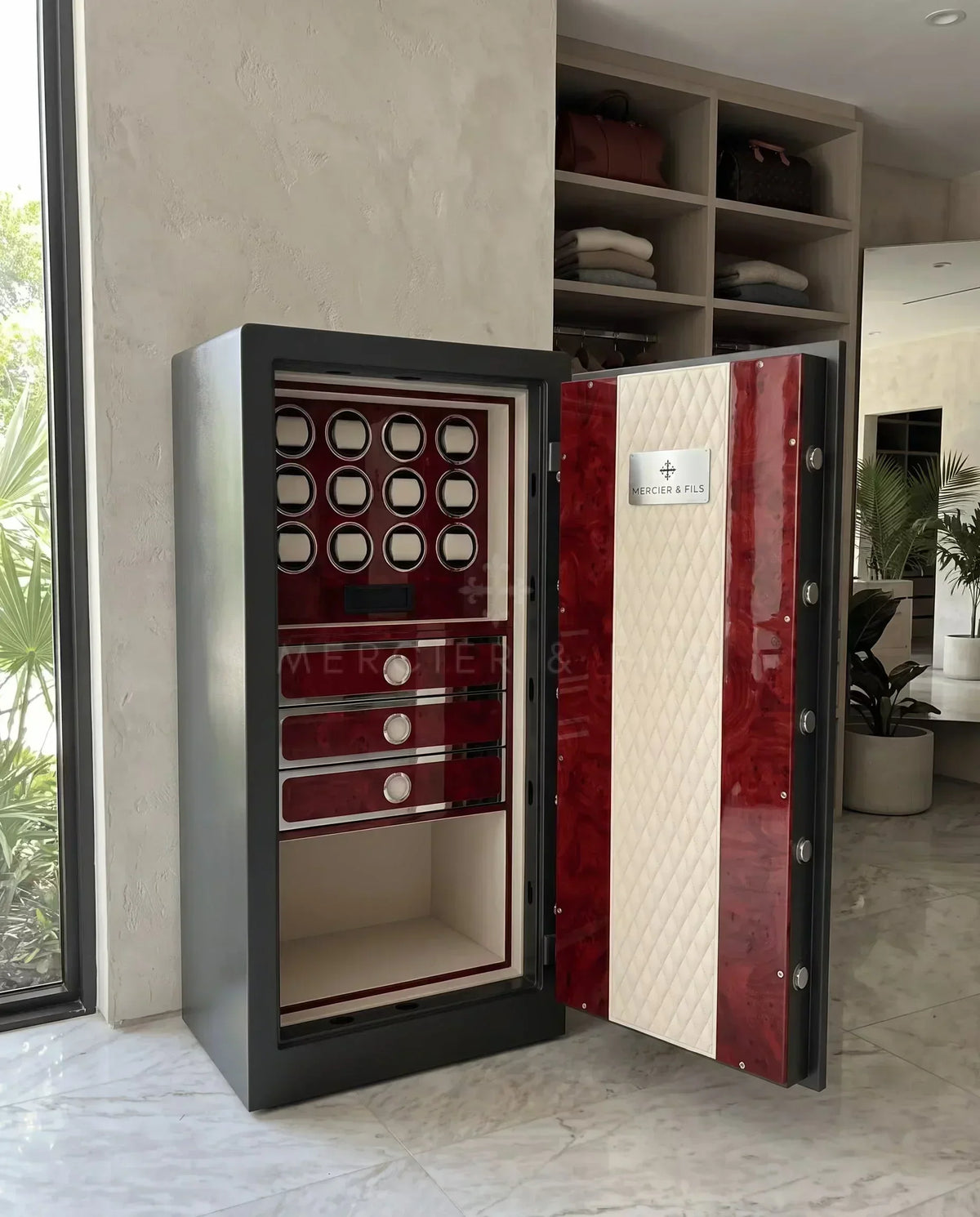
Across our collection of watch safes, the protection level is considered alongside the capacity, interior layout, and finishes of your Régent. A security configuration is selected for its construction and specific characteristics; the interior is then composed around your collection.
TimeDrive™ M1, powered by Coil Winding Technology, provides individual settings for each watch winder. The lock and storage choices complete that configuration. Your advisor helps bring these elements together in a proposal tailored to your project.
Discuss your Régent configuration · Explore Mercier & Fils technologies
Our method and references
Documentary analysis conducted October 9, 2026 using UL 687’s public scope, ECB•S guidance, a technical presentation hosted by TISI, and manufacturer publications. The complete standards and product cross-test reports were not audited in this study.
- UL Standards & Engagement — classifications and scope
- ECB•S R08 — test-report contents
- American Security — tools and entry criteria
- INKAS — active working time
- J.SH catalog — classification guide, p. 16
- Dominator — published product positioning
- TISI-hosted presentation — system comparison, p. 45
- European Certification Body — role and accreditation
- ECB•S — reading the certification mark
- ECB•S R08 — type-test guide, May 2018, pp. 2–8
- ECB•S C10 — certification and surveillance, February 2025
- UL — organizations and roles
The comparisons help explain and position the classifications. Certification references and any purchasing requirements remain specific to the selected configuration.
Cet article fait partie du Journal Mercier & Fils, guide de référence sur la conservation et le remontage des montres automatiques de collection. Pour toute question technique sur un calibre spécifique non documenté ici, l'équipe Mercier & Fils peut être contactée pour une vérification personnalisée.
Read more
Choosing a watch safe often starts with an apparently simple question: how many watches does it need to hold? In the projects we discuss with collectors, that is rarely the hardest question. The n...
A 30-minute claim alone does not describe fire protection. Understand UL 72, Class 350, European LFS ratings, and the evidence behind an advertised result.
Leave a comment
All comments are moderated before being published.
This site is protected by hCaptcha and the hCaptcha Privacy Policy and Terms of Service apply.