



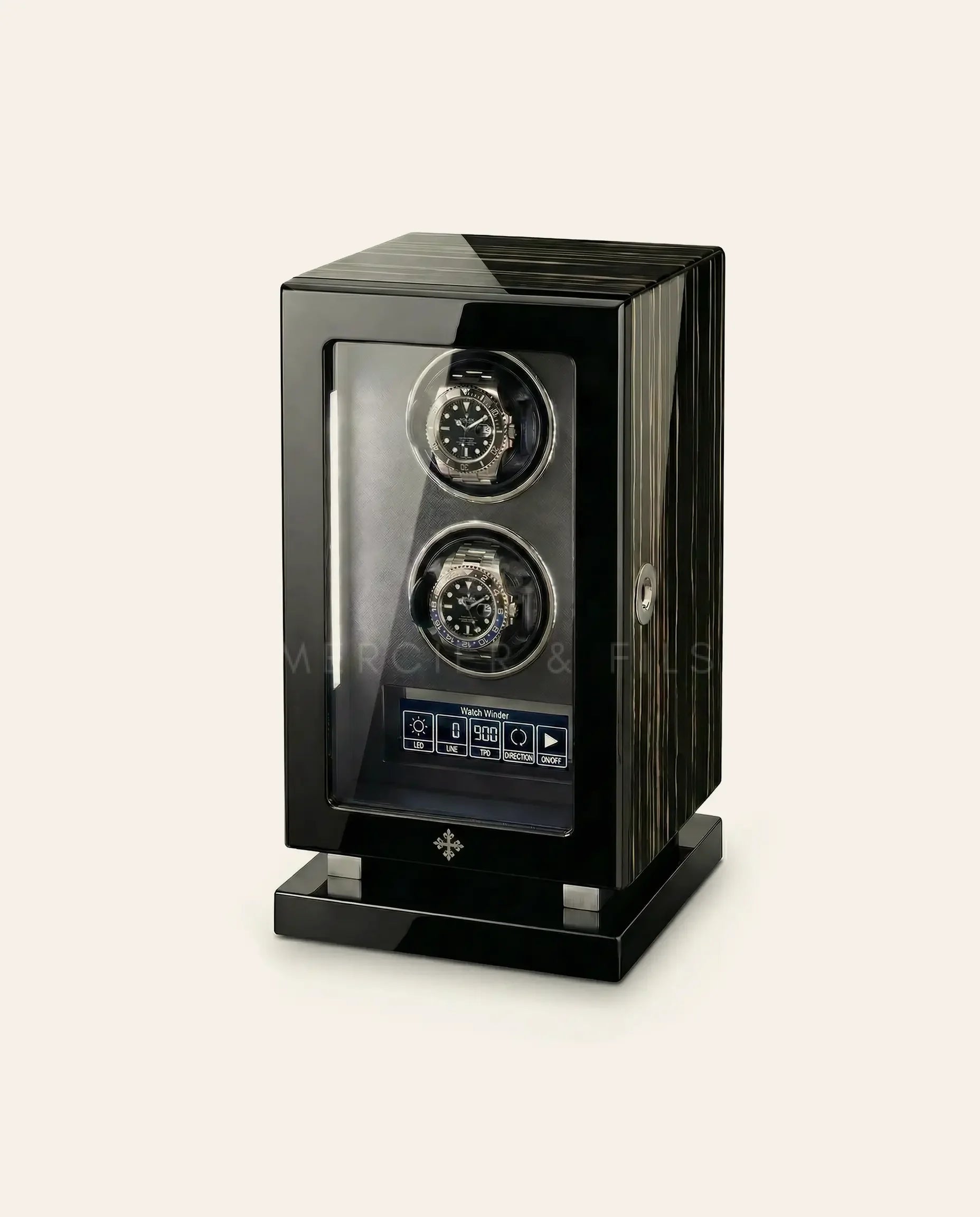

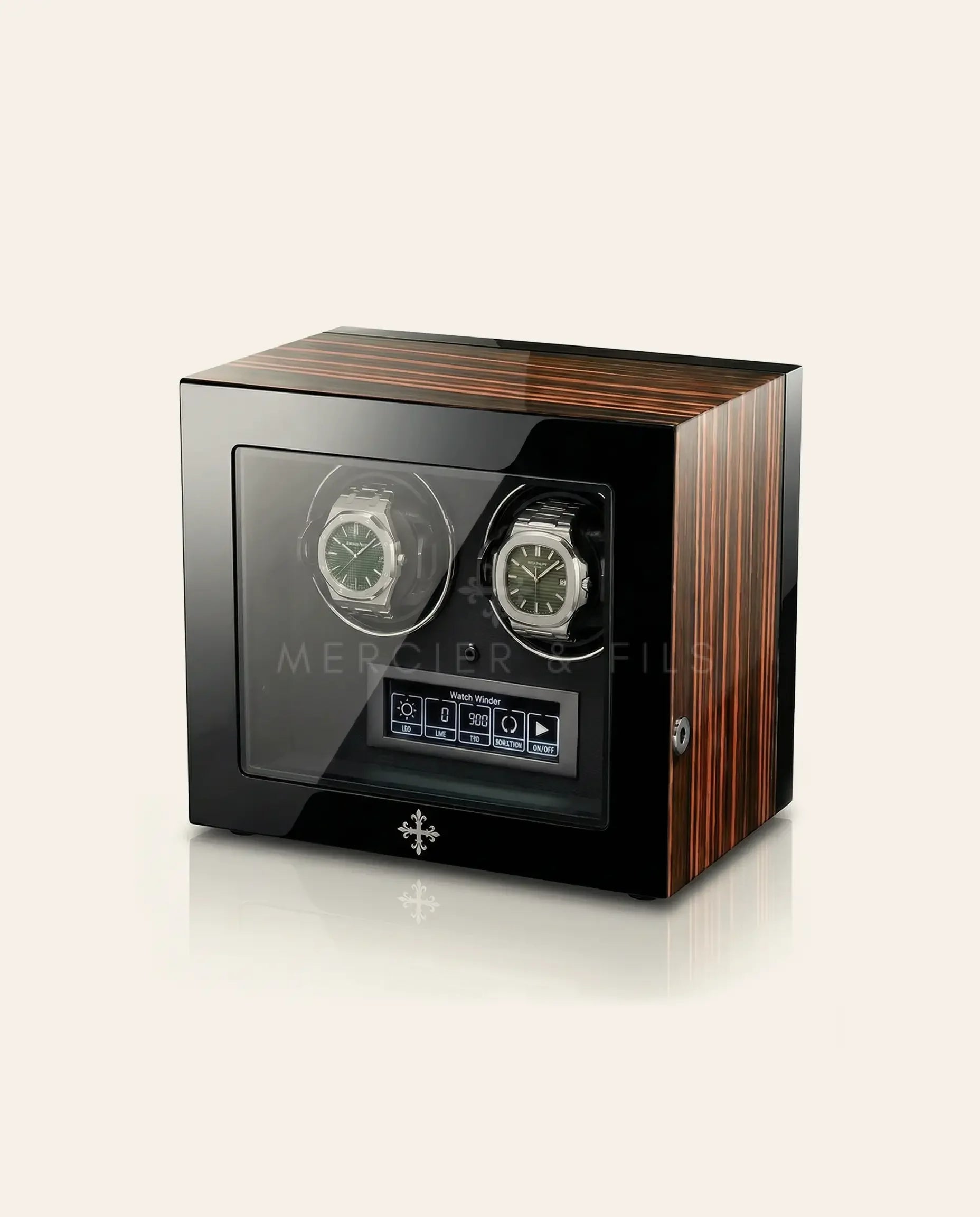

Winder rotation direction: CW, CCW, BOTH — understanding it all

Updated 9 September 2026.
CW, CCW and BOTH describe how the watch holder rotates. The right choice depends on your exact calibre and your winder’s conventions. Bidirectional mode is not automatically best, and a brand name alone cannot determine the programme.
CW, CCW and BOTH: the three modes
| Mode | Holder movement | What to check |
|---|---|---|
| CW | Clockwise | The viewing direction specified in the manual. |
| CCW | Counterclockwise | The recommendation for the calibre and winder. |
| BOTH | Alternates directions | How turns are distributed and counted. |
CW means Clockwise; CCW means Counter-Clockwise. BOTH alternates directions: the holder does not rotate both ways simultaneously. Use the manufacturer’s stated viewpoint. A direction viewed from behind appears reversed when viewed from the front.
Holder direction and winding system are different
The winder moves the watch; its automatic mechanism recovers energy from rotor movement. Depending on the calibre, winding can operate in one direction or both. This feature alone does not tell you how to translate movement observed through a case back into a CW or CCW button setting.
Ask for a recommendation specifically for watch-winder use. Do not infer settings for a Royal Oak, Nautilus or Submariner from the collection name alone: identify the reference and movement.
Does BOTH double efficiency?
No. Alternating directions does not establish that twice as much energy reaches the watch. Total rotations, distribution, pauses and the winding mechanism all matter. Nor can you assume that BOTH always halves efficiency.
A purely arithmetic example: if a manual defines 800 total turns divided equally, that means 400 in each direction. This describes the holder, not measured energy delivered to the mainspring. If the display indicates turns per direction, the total will differ.


How to select the setting
- Check that the watch is automatic: a rotating winder does not wind a manual or quartz movement.
- Identify the exact reference and calibre through the watch documentation or after-sales service.
- Have direction and turns confirmed for your device. If the watchmaker does not publish values, explain that uncertainty to the winder manufacturer.
- Read the turn-counting convention and pauses in the manual, then configure each relevant module.
- If the watch stops, check its initial winding, mounting and condition before increasing the setting.
Identify your reference with our guides: Rolex · Audemars Piguet · Patek Philippe · Omega.
FAQ
Does BOTH suit every watch?
No. An alternating programme must suit the calibre and be counted correctly. It is not a substitute for a verified recommendation.
My winder has no CCW-only mode: is it incompatible?
Not necessarily. An alternating programme may work in some cases, but its suitable cadence needs confirmation. Do not assume compatibility or incompatibility without checking.
Does the wrong direction stop a watch immediately?
Not necessarily: its remaining power reserve matters. A stopped watch alone therefore does not diagnose the rotation direction.
How are direction and TPD related?
Direction describes holder movement; TPD describes daily turns under the manufacturer’s convention. Check both together.
Further reading
Understanding watch-winder TPD explains turn counting. To choose a device, explore our automatic watch winder collection.
Cet article fait partie du Journal Mercier & Fils, guide de référence sur la conservation et le remontage des montres automatiques de collection. Pour toute question technique sur un calibre spécifique non documenté ici, l'équipe Mercier & Fils peut être contactée pour une vérification personnalisée.

Read more

A Rolex Submariner worn in rotation with other watches may benefit from a winder, but the setting should start with its exact reference. This guide separates what Rolex documents about the movement...

Father's Day is the only time of year when you realize you don't know what to get someone you know perfectly well. The man who has everything wants for nothing — and that's precisely the problem. A...
Leave a comment
All comments are moderated before being published.
This site is protected by hCaptcha and the hCaptcha Privacy Policy and Terms of Service apply.