


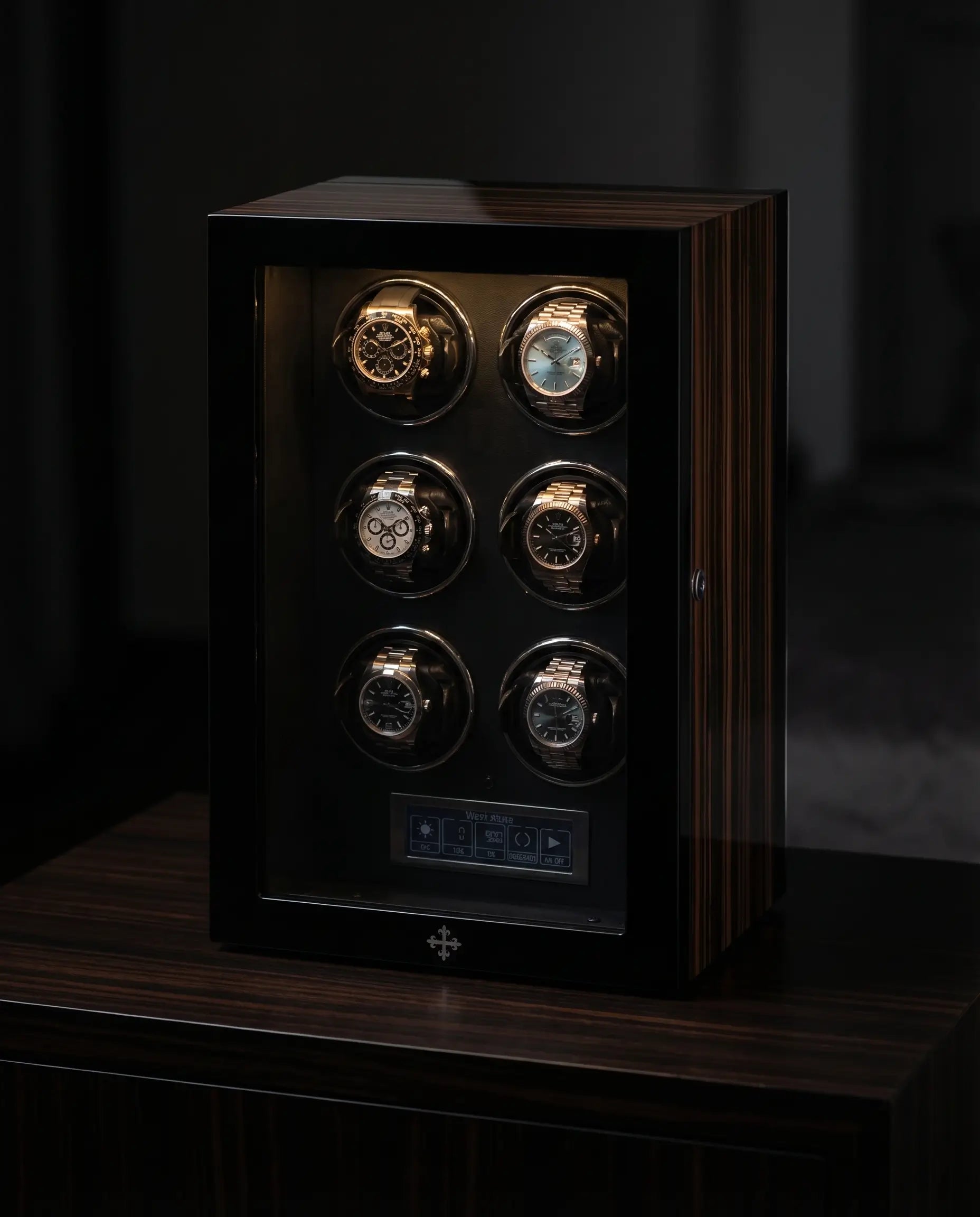
Silent watch winder: the forgotten criterion

The watch winder turns. In the background, in the office or on the nightstand. And after a few days, the noise settles in — that continuous hum that eventually becomes a presence. This is not inevitable. It's a sign of a poorly designed motor.
Noise level is the criterion most often missing from watch winder product sheets. Yet, it is one of the most reliable indicators of a device's mechanical quality. A silent watch winder is not a luxury — it is the direct consequence of a motor that runs correctly.
Why does a watch winder make noise?
The noise from a watch winder has a single source: the motor. More precisely, the quality of its rotation. A low-end motor operates in impulses — it turns in jerks, with frequency variations that generate micro-vibrations. These vibrations propagate through the chassis, the casing, and ultimately through any surface on which the winder is placed.
A precision motor, conversely, maintains continuous and regular rotation at a controlled frequency. There are no jerks, no amplitude variations — and therefore no parasitic vibrations to propagate. Silence is the result of controlled rotation, not acoustic insulation.
The casing, the wood, the glass — none of these materials significantly absorb noise if the motor produces it. A solid oak winder with a bad motor will remain noisy. A winder with a good motor in a simple casing will be inaudible.
Noise level in practice: what the numbers mean
Sound is measured in decibels (dB). Here are a few concrete references to understand what each threshold represents in a domestic context:
A sound level needs a measurement distance, background level and number of active modules to be meaningful. There is no universal threshold guaranteeing that a watch winder will be inaudible in every bedroom. A-weighting, indicated by dBA, and the average LAeq level describe the measurement.
Most entry-level watch winder manufacturers do not publish any sound data. This silence about silence is a signal in itself. Manufacturers who master their motors publish their figures — those who do not master them prefer not to mention them.
The motor: the only variable that matters
The acoustic quality of a watch winder depends entirely on the motor. Its architecture determines whether the rotation is regular or jerky, whether vibrations are absorbed internally or propagated externally.
Coil Winding®: 20.1 dBA with one module, 23.4 dBA with twelve active modules, at 30 cm. LAeq results from our Rivoli 12 reference test, against an initial background of 18.6 dBA. A motor design shared across the range, with measured performance. Explore our testing.

Silent watch winder and TPD precision: the two go hand in hand
A silent motor is a motor that rotates regularly. An irregular motor, conversely, simultaneously produces two defects: noise and imprecise TPD. Both have exactly the same cause — uncontrolled rotation.
On a motor with varying frequency, the actual rotations deviate from the programmed value. The deviation can reach 15 to 20% on entry-level motors — meaning up to 130 missing rotations per day on a caliber programmed at 650 TPD. This invisible deficit does not manifest immediately but progressively reduces the power reserve, especially on complication watches.
Choosing a silent watch winder therefore means choosing a precise watch winder. The two qualities are inseparable. To understand why TPD and rotation direction are the key parameters for good adjustment, consult the Mercier & Fils TPD guide and the article on CW, CCW, BOTH rotation direction.
Where to place your watch winder to minimize sound perception
A stable, low-resonance surface, clearance around the case and a suitable distance from the bed help reduce disturbance. Avoid direct contact with a partition. Assess operation in your own room: a given distance does not guarantee inaudibility.
These precautions do not compensate for a bad motor. They optimize a good one.


FAQ
Does a watch winder make noise?
Coil Winding®: 20.1 dBA with one module, 23.4 dBA with twelve active modules, at 30 cm. LAeq results from our Rivoli 12 reference test, against an initial background of 18.6 dBA. A motor design shared across the range, with measured performance. Explore our testing.
What is the sound level for a silent watch winder?
A sound level needs a measurement distance, background level and number of active modules to be meaningful. There is no universal threshold guaranteeing that a watch winder will be inaudible in every bedroom. A-weighting, indicated by dBA, and the average LAeq level describe the measurement.
Can a watch winder's noise damage a watch?
The noise itself does not damage the watch. However, a noisy motor is usually also an imprecise motor — its irregular rotation produces a real TPD lower than the displayed value. This deficit in rotations can reduce the power reserve and, on complication watches, cause progressive stops. The problem is therefore not acoustic, but mechanical.
How do I know if my watch winder is too noisy?
To compare such low sound levels, use a suitable sound level meter, a fixed distance and a background reading with the device switched off. A phone app may help detect a change, but does not replace instrumented low-level measurements.
Explore our Coil Winding® watch winders: during the seven-day Rivoli 12 test at 650 TPD / BOTH, the measured average was 646.7 turns/day, a −0.51% deviation from the setting. Coil Winding®: 20.1 dBA with one module, 23.4 dBA with twelve active modules, at 30 cm. LAeq results from our Rivoli 12 reference test, against an initial background of 18.6 dBA. A motor design shared across the range, with measured performance. Explore our testing.
This article is part of the Mercier & Fils Journal, a reference guide on the preservation and winding of automatic collection watches.
To compare the Mazarin and Rivoli formats in the capacity used for our reference test, explore our 12-watch winders. The measurements quoted here apply to the tested Rivoli 12, not every model with this capacity.
Cet article fait partie du Journal Mercier & Fils, guide de référence sur la conservation et le remontage des montres automatiques de collection. Pour toute question technique sur un calibre spécifique non documenté ici, l'équipe Mercier & Fils peut être contactée pour une vérification personnalisée.
Read more

Father's Day is the only time of year when you realize you don't know what to get someone you know perfectly well. The man who has everything wants for nothing — and that's precisely the problem. A...

Updated 9 September 2026.TPD means Turns Per Day: the daily turn count programmed on a watch winder. It concerns the watch holder’s rotation, not motor speed, rotor revolutions or a direct measurem...
Leave a comment
All comments are moderated before being published.
This site is protected by hCaptcha and the hCaptcha Privacy Policy and Terms of Service apply.