



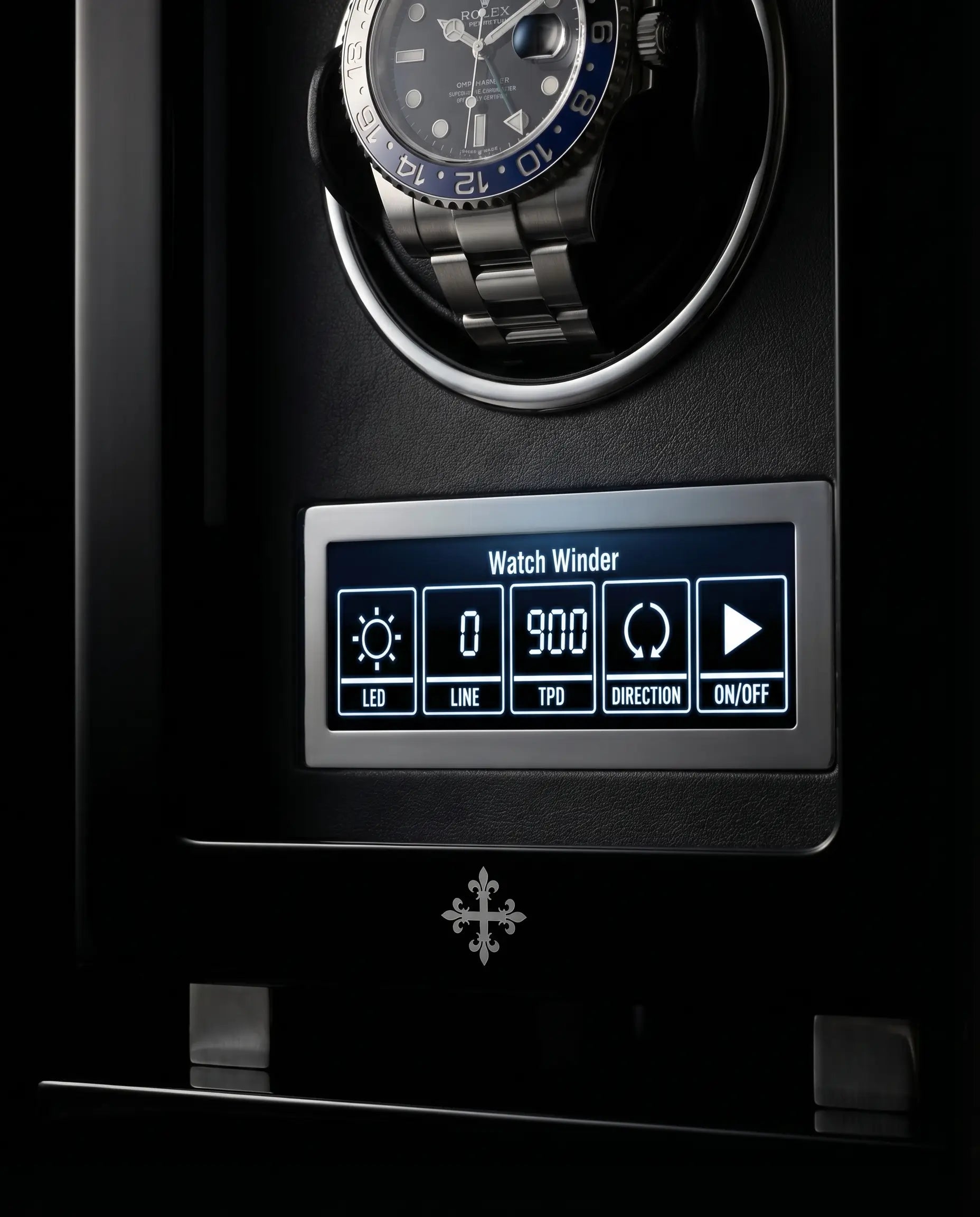
Understanding the TPD of an automatic watch winder
TPD is the most important setting parameter for an automatic watch winder. TPD stands for turns per day. If set incorrectly, it can cause a watch to stop unexpectedly. If set correctly, it maintains the movement at its nominal operating point, just as a wrist would. This guide explains what TPD is, how it is calculated, why it varies from one caliber to another, and provides recommended values for the five major watch manufacturers: Rolex, Audemars Piguet, Patek Philippe, Omega, and Vacheron Constantin.
What is TPD? TPD refers to the number of rotations a winder performs in 24 hours. The majority of modern automatic watches operate between 650 and 800 TPD. Rolex requires 650 bidirectional TPD across its entire current range. Audemars Piguet varies by caliber, from 650 BOTH to 800 CW or CCW. Patek Philippe mostly operates at 800 TPD counter-clockwise. Omega fluctuates between 650 and 800 TPD. Vacheron Constantin is mainly at 650 bidirectional TPD. Incorrect TPD settings do not damage a watch but can reduce its winding efficiency by half.
Published on May 7, 2026 — Updated on May 7, 2026 — Reviewed by the Mercier & Fils technical team.
TPD in detail: definition and operation
The acronym TPD comes from turns per day. It refers to the number of complete rotations a winder performs on an automatic watch over a 24-hour period. This value is not arbitrary: it corresponds to the minimum number of rotations required to maintain the mainspring of a given caliber at its nominal tension level, thus simulating the natural movement of a human wrist over the course of a day.
An active wrist generates an average of 600 to 800 rotations per day, depending on lifestyle, physical activity, and movement architecture. This is the range that watch manufacturers have used as a reference to define their winding specifications. A watch winder mechanically reproduces this movement by rotating the watch holder around its axis, at a programmed rate that must correspond to the TPD recommended by the manufacturer.
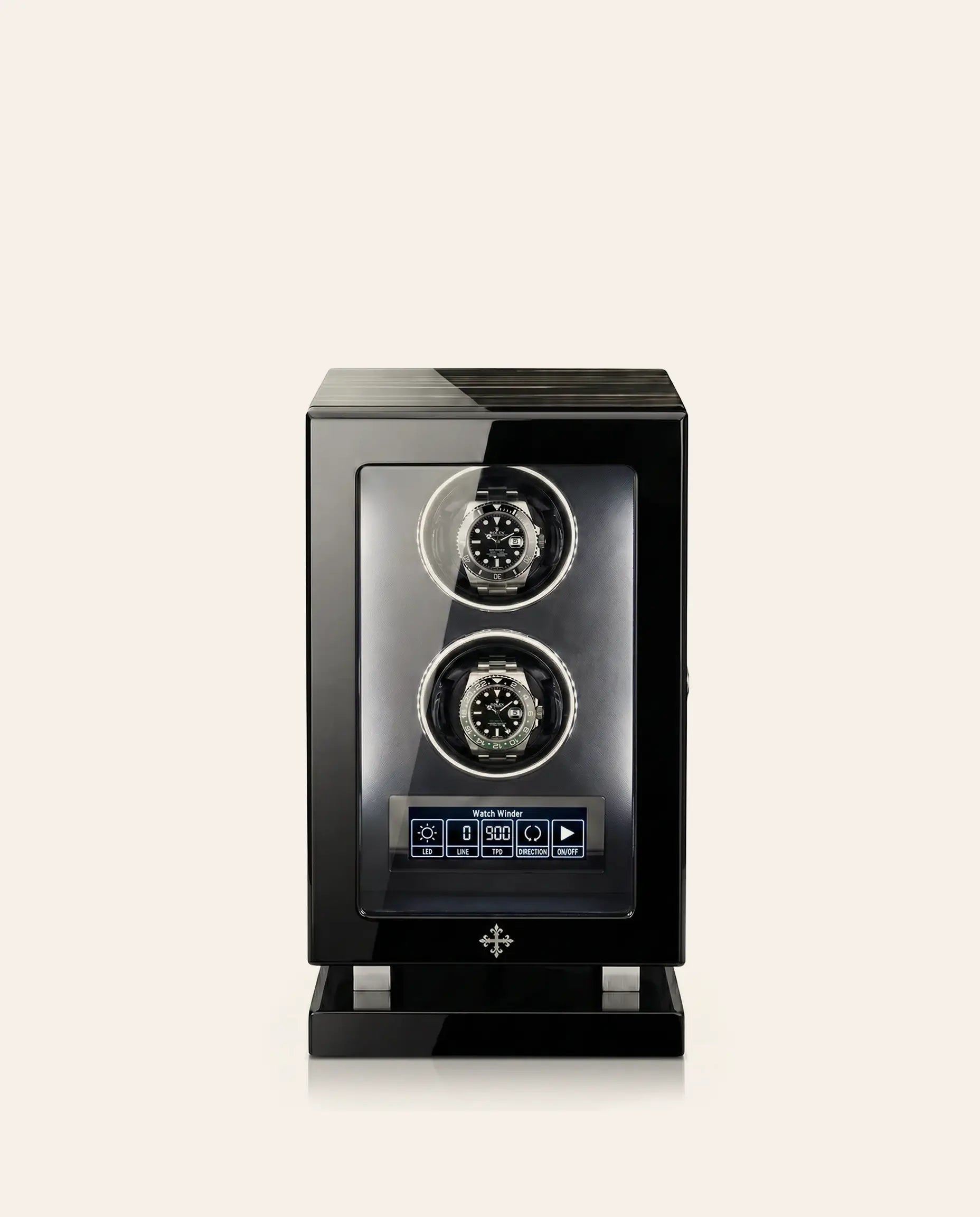
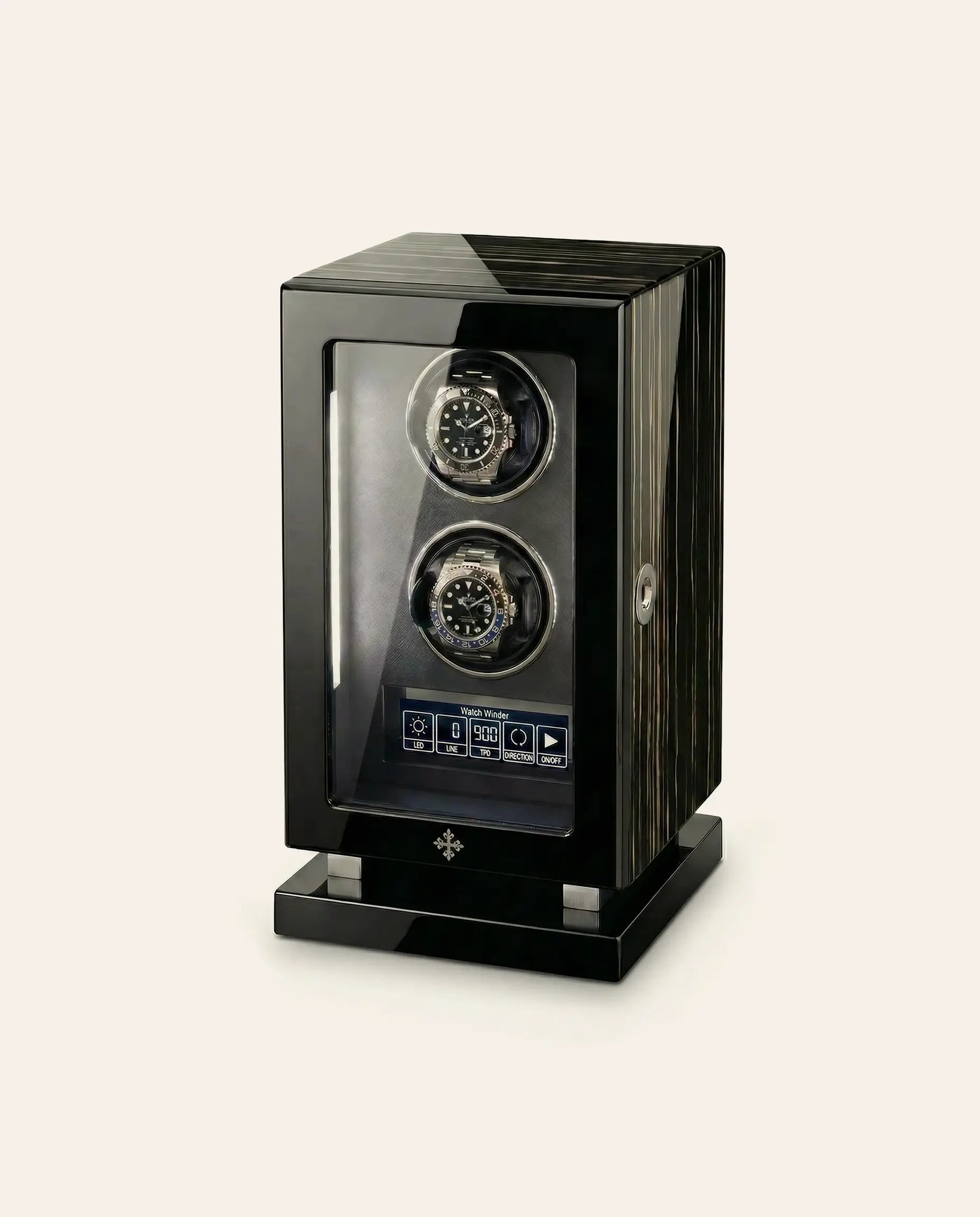
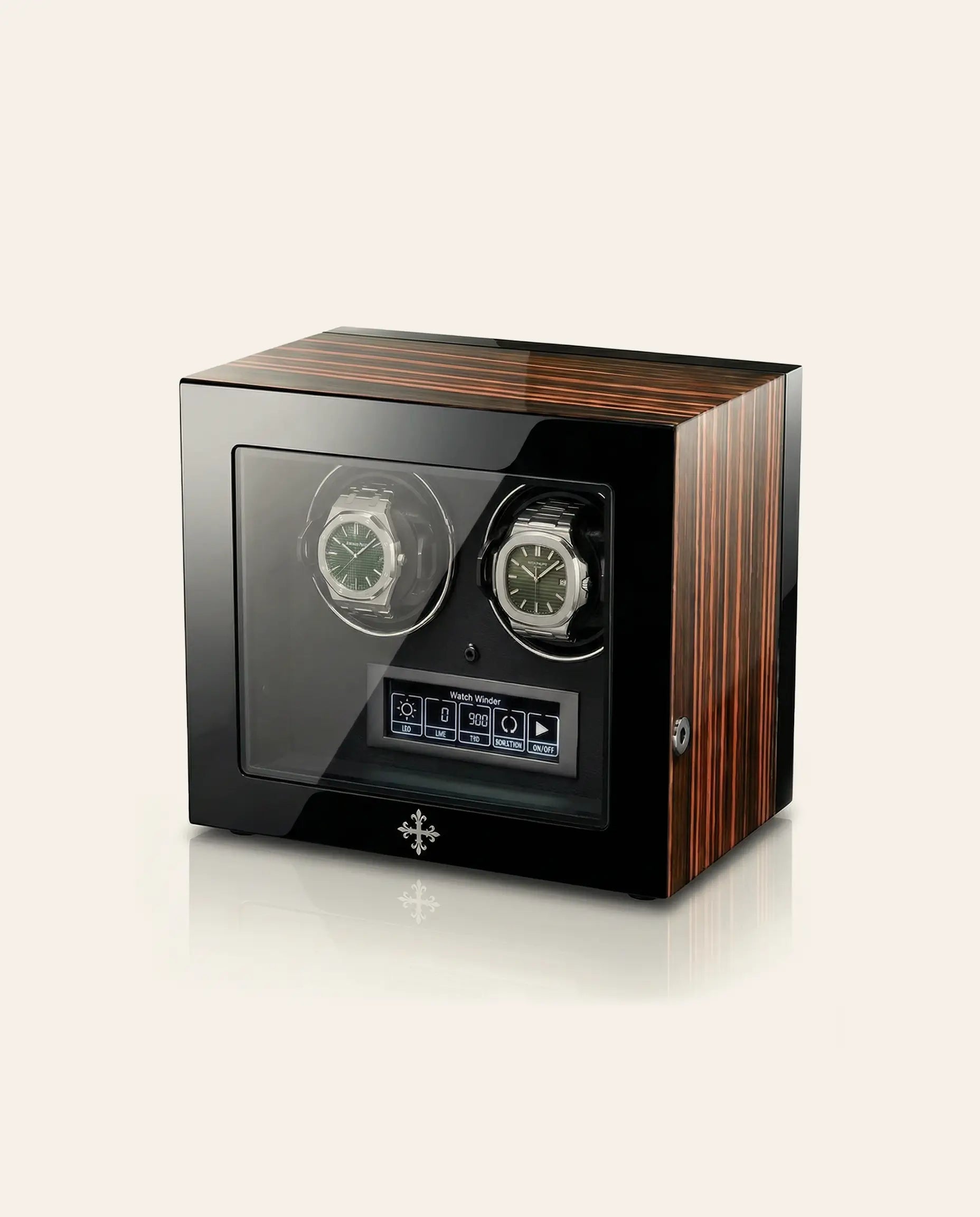
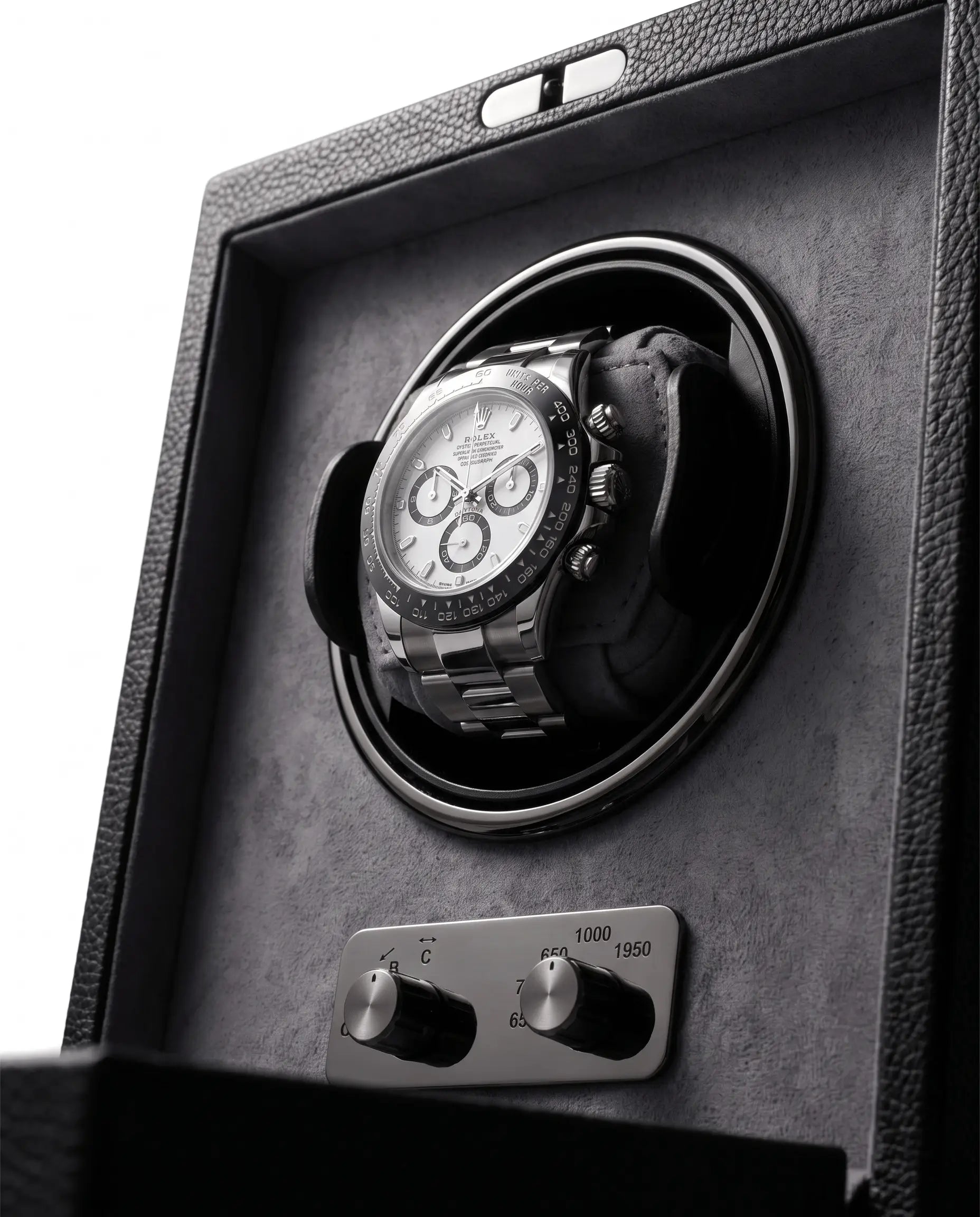
The TPD is set directly on the winder, usually via a touchscreen or configuration buttons. On configurable models, each module has its own independent settings, allowing multiple watches with different requirements to be accommodated simultaneously — as offered by the Mazarin and Rivoli winders from the Mercier & Fils collection.
Why TPD is the number one parameter of a watch winder
On a watch winder, two main parameters are configurable: TPD and rotation direction. Both are important, but their effects are not symmetrical. The direction of rotation determines whether energy is recovered by the movement's rotor; TPD determines how much energy is recovered. An incorrect direction makes winding completely ineffective. Insufficient TPD makes winding partially ineffective. Excessive TPD provides no additional benefit and, on some calibers, can accelerate component wear.

Key takeaway — TPD is the winding parameter. Rotation direction is the efficiency parameter. Correct TPD in the wrong direction remains ineffective. Correct direction with insufficient TPD partially maintains the watch. Both must be correct for optimal winding.
How TPD is calculated: the mechanics of the rotor
An automatic watch is wound by a rotor—a semicircular oscillating weight fixed to the central axis of the movement. With each wrist movement, the rotor pivots under the effect of gravity, and its pivot transmits energy to the mainspring via a gear train. The number of rotations required to achieve a full wind depends on several factors specific to each caliber: gear train reduction ratio, rotor mass, internal friction, and architecture of the anti-recoil system.
This is why a Rolex 3235 caliber requires 650 TPD, while an Audemars Piguet 2385 caliber requires 800. The difference does not stem from a question of quality, but of design. A high-ratio winding train winds faster but with less torque; a low-ratio train requires more rotations but offers a better power reserve. Each manufacturer optimizes these parameters according to its watchmaking philosophy.
TPD too low or too high: what really happens
A TPD that is too low is the most common scenario. The watch does not receive enough energy over 24 hours, the mainspring gradually unwinds, and the power reserve decreases day by day. For a simple watch, this results in it stopping after a few days on the winder. For a watch with complications—perpetual calendar, moon phases, equation of time—stopping triggers a complete resetting of all indications, a long and technically delicate operation that alone justifies the use of a properly set winder.
A TPD that is too high is less problematic than one might think, but it is not neutral. All modern calibers include a disengagement device that prevents overwinding: once the spring is at its maximum tension, the mechanism slips to absorb excess rotations. This device is designed to operate episodically, not continuously. An oversized winder in terms of TPD constantly stresses this disengagement mechanism, which provides no winding benefit and can, in the long term, accelerate component wear. The cautious rule: approach the manufacturer's value, without significantly exceeding it.
Key takeaway — Insufficient TPD causes a watch to stop. Excessive TPD does not immediately damage it, but unnecessarily stresses the disengagement mechanism. The manufacturer's value is always the reference to follow.
Reference table: TPD by brand
The table below summarizes the dominant values for the five major manufacturers, based on the analysis of over 1,000 references from the Mercier & Fils winding specifications database.
| Manufacturer | Dominant Direction | Dominant TPD | Specificity |
|---|---|---|---|
| Rolex | BOTH | 650 | Total universality, entire range aligned |
| Audemars Piguet | BOTH (78%) | 650 or 800 | Heterogeneous, verification by caliber indispensable |
| Patek Philippe | CCW (84%) | 800 | Counter-clockwise majority — notable exception |
| Omega | BOTH (71%) | 650 | Mix of BOTH and CW depending on caliber generation |
| Vacheron Constantin | BOTH (65%) | 650 | Intermediate pattern, older calibers are unidirectional |
Rolex TPD: 650 BOTH universal
Rolex is, among the major manufacturers, the one with the most homogeneous specification. Based on the analysis of 314 references covering the entirety of modern production, the vast majority of calibers operate at 650 TPD in bidirectional mode. This uniformity reflects the manufacturer's industrial philosophy: a limited number of highly standardized calibers, optimized for reliability and interoperability.
The calibers concerned cover all current collections: 3235 (Submariner Date, Datejust 41, Yacht-Master), 3230 (no-date Submariner, Explorer), 4130 and 4131 (ceramic Daytona and platinum Daytona), 3285 (GMT-Master II, Explorer II), 3255 (Day-Date 40), 3155 (older generation Day-Date 36), and the entire Cellini range. The rare exceptions at 800 TPD concern older calibers, prior to the 1980s, now out of production. Details by reference can be found on the Rolex TPD page.
For a Rolex owner, the setting is therefore trivial: 650 TPD, bidirectional mode. No caliber-by-caliber verification is necessary for models produced since the 2000s.
Audemars Piguet TPD: caliber-by-caliber complexity
Unlike Rolex, Audemars Piguet presents the most heterogeneous profile among the five major manufacturers. Out of 163 references analyzed, the direction of rotation is distributed as 78% bidirectional, 11% clockwise, and 11% counter-clockwise. TPD mainly oscillates between 650 and 800 depending on the caliber. This diversity reflects a longer watchmaking history and diversified production across Royal Oak, Royal Oak Offshore, Code 11.59, Jules Audemars, and complications.
The most widely diffused bidirectional calibers are the 3120 (Royal Oak 15400, 15500) at 650 TPD, the 4302 (Code 11.59 and recent Royal Oak) at 650 TPD, and the 2120/2121 (Royal Oak Jumbo extra-thin) at 800 TPD. Unidirectional calibers are notable exceptions: the 2385 (Royal Oak chronograph 26331) operates clockwise at 800 TPD, while the 2324, 2325, 2326, 2329, and 2885 family operates counter-clockwise at 800 TPD. The 5135 caliber (Perpetual Calendar) also follows a specific scheme. Full details are available on the Audemars Piguet TPD page.
For a Royal Oak owner, caliber verification is essential before any setting. A Royal Oak Chronograph set to 650 BOTH instead of 800 CW will experience a continuously declining power reserve. For such a piece, the use of a winder independently configurable per module is not a comfort, it is a technical necessity.
Patek Philippe TPD: the specificity of counter-clockwise direction
Patek Philippe exhibits the most surprising pattern in the table, and one of the least known to the public. Out of 211 references analyzed, 84% of calibers operate counter-clockwise. This is not an exception; it is the manufacturer's rule. The calibers concerned include the 324 SC (Aquanaut 5167, older Nautilus), the 26-330 SC (Nautilus 5711, 5811), the 240 (Calatrava extra-thin), and almost all calibers with micro-rotor automatism.
The dominant TPD is 800, not 650 as with Rolex. This combination—800 TPD counter-clockwise—characterizes Patek's mechanical signature. It results from the historical architecture of their in-house micro-rotors, whose winding direction and reduction ratio have been standardized over decades.
For a Patek Philippe owner, a winder set by default to 650 BOTH—the factory configuration for most entry-level winders—is unsuitable. The watch will receive approximately 50% of the necessary energy (BOTH instead of CCW cancels half of the useful rotations) and will operate in an insufficient tension range (650 instead of 800). The result is almost systematically a stop within three to five days.
Key takeaway — Patek Philippe is the great exception in the contemporary watchmaking landscape. Where Rolex dictates 650 BOTH, Patek requires 800 CCW for the majority of its calibers. Any winder intended for a Patek must imperatively have independent settings for rotation direction and TPD.
Omega TPD: the transition between generations
Omega occupies an intermediate position, with a distribution of 71% bidirectional and 29% clockwise across 243 references. The dominant TPD is 650, but a significant portion of production is at 700 or 800 depending on the caliber. This diversity reflects the coexistence of several generations of movements in circulation — from the historical 1120 caliber to the current Co-Axial Master Chronometer in-house calibers.
The most widespread recent calibers follow stable specifications: 8800 and 8900 (Seamaster Diver 300m, Aqua Terra) at 650 BOTH, 9300 and 9900 (modern automatic Speedmaster) at 650 BOTH, 8500 and 8501 (older Seamaster Co-Axial) also at 650 BOTH. Clockwise calibers mainly concern older series or specific limited editions, such as some Globemaster and Aqua Terra Annual Calendar at 700 TPD CW.
Important note: the Mercier & Fils winding specifications database allows for reference-by-reference verification. Speedmaster watches equipped with caliber 1861 or 3861 are manual-winding and do not require a winder — these models are outside the scope of this guide.
Vacheron Constantin TPD: 650 BOTH dominant with exceptions
Vacheron Constantin exhibits a profile close to a market average. Out of 104 references analyzed, 65% operate bidirectionally, 19% clockwise, and 15% counter-clockwise. TPD is largely dominated by 650, covering 83% of production.
The most widespread modern calibers follow this standard: 5100 and 5101 (current Overseas, from 2016) at 650 BOTH, 2450 (Patrimony, simple Traditionnelle) at 650 BOTH, 2460 (Patrimony and Quai de l'Île variants) at 650 BOTH. Exceptions concern the older generation Overseas equipped with caliber 1137 (CW at 800 TPD), and certain complex pieces—Malte Dual Time, Harmony Chronograph, Overseas Chronograph 5500—whose TPD and direction vary according to the integrated complication.
For the majority of Vacheron watches post-2016, the 650 BOTH setting is suitable. For older or complicated pieces, caliber-by-caliber verification is still recommended.
Mercier & Fils Methodology: how we establish recommended TPDs
The values presented in this guide are not the result of a compilation from forums or secondary sources. They are established according to a four-step methodology, applied to each referenced caliber.
Step 1 — Manufacturer documentation. When available, official manufacturer documentation is the primary source. This includes accompanying technical notes, service sheets, and specifications published in chronometry certificates.
Step 2 — Empirical verification on an amplitude bench. In the absence of official documentation, or in case of doubt about an old reference, the caliber is tested on a configurable winder, and amplitude is measured at regular intervals over 72 hours. The stabilization curve determines the effective TPD range.
Step 3 — Multi-source cross-referencing. The obtained values are systematically cross-referenced with the industry's reference technical databases, as well as with feedback from independent watchmakers specializing in the brand concerned.
Step 4 — Prudent recommendation. In case of discrepancy between sources, the more conservative value is retained, meaning the one that ensures the power reserve is maintained without excessively stressing the clutch mechanism.
Configuring a multi-module watch winder for a collection
A watch collection rarely contains watches with identical specifications. A Rolex Submariner (650 BOTH), a Royal Oak Chronograph (800 CW), and a Nautilus 5711 (800 CCW) frequently coexist on the same dresser — and their three calibers require three strictly distinct settings. A single-module or globally programmable winder cannot accommodate this diversity: it properly maintains one watch out of three and destabilizes the other two.
On Mercier & Fils winders, each module is independent. The direction of rotation and TPD are programmed separately for each slot from the central touchscreen. One module can be set to 650 BOTH for a Rolex, the neighboring module to 800 CCW for a Patek, and the next to 800 CW for an AP Royal Oak Chronograph. This modularity is the technical prerequisite for any diversified collection. The Mazarin Macassar ebony and Rivoli black zebrano winders are available in 2 to 24 slots in the Mercier & Fils watch winder collection.


For a collection valued over €10,000, integrating the winder into a biometric safe combines mechanical maintenance with security. The Louvois and Tiphaine safes for automatic watches incorporate winding modules with the same independence per slot, without compromising preservation.
Common TPD setting errors
Setting all modules to the same default value. This is the most frequent error. A uniform setting of 650 BOTH or 800 BOTH is suitable for a homogeneous collection from a single manufacturer but becomes inappropriate as soon as a second brand is introduced. The setting must be done caliber by caliber.
Confusing TPD with operating time. TPD is a number of rotations over 24 hours, not an engine run time. A 650 TPD winder can complete its rotations in 30 minutes or 4 hours, depending on the programming of activity and pause cycles. A good winder alternates rotation phases with rest phases to replicate the natural wrist movement.
Ignoring the direction of rotation. TPD alone is not enough. A Patek 324 SC caliber set to 800 BOTH instead of 800 CCW receives half the useful energy. Direction and TPD are two inseparable parameters.
Oversizing out of excessive caution. Programming 1,200 TPD because the caliber requires 800 does not maintain the watch better. It simply constantly stresses the clutch mechanism. The rule is to aim for the manufacturer's value, not above.
FAQ
What is TPD on a watch winder?
TPD, or turns per day, refers to the number of rotations a watch winder performs on an automatic watch in 24 hours. This value corresponds to the number of rotations needed to maintain the mainspring at its nominal tension, simulating the movement of a human wrist during a normal day's activity.
What TPD for an automatic watch in general?
Most modern automatic watches operate between 650 and 800 TPD. In the absence of manufacturer information, 800 TPD bidirectional is an acceptable default setting for most contemporary calibers. The exact value depends on the caliber and should ideally be verified against manufacturer specifications.
What TPD for a Rolex?
All modern Rolex watches operate at 650 TPD in bidirectional mode. This specification covers all calibers in production: 3235, 3230, 4130, 4131, 3285, 3255, and others. No current Rolex requires unidirectional rotation or a different TPD.
What TPD for an Audemars Piguet Royal Oak?
The TPD of a Royal Oak depends on the caliber. The 3120 (15400, 15500) operates at 650 TPD bidirectional. The 2121 (Jumbo 15202) at 800 TPD bidirectional. The 2385 (Chronograph 26331) at 800 TPD in clockwise direction. The 4302 (recent Royal Oak) at 650 TPD bidirectional. Verification of the exact caliber is essential before any adjustment.
What TPD for a Patek Philippe Nautilus or Aquanaut?
The majority of Patek Philippe watches operate at 800 TPD in counter-clockwise (CCW) direction. This includes caliber 324 SC (Aquanaut 5167, older Nautilus), 26-330 SC (Nautilus 5711, 5811), and 240 (Calatrava extra-flat). A winder set to the standard 650 BOTH is unsuitable for Patek Philippe.
What happens if the TPD is too low?
A TPD that is too low does not provide enough energy to the mainspring over 24 hours. The power reserve gradually decreases, and the watch eventually stops. For a watch with complications (perpetual calendar, moon phases), stopping requires a complete resetting of all indications.
What happens if the TPD is too high?
A TPD that is too high does not immediately damage the watch. All modern calibers include a clutch mechanism that prevents over-winding. However, a significantly excessive TPD constantly stresses this mechanism, which can accelerate its long-term wear. The rule is to aim for the manufacturer's value, without exceeding it significantly.
Can an incorrect TPD damage a watch?
An insufficient TPD does not damage the watch; it simply lets it stop. A moderately excessive TPD does not immediately damage a watch either, thanks to the clutch mechanism. A very excessive TPD (two to three times the manufacturer's value) continuously stresses this mechanism and can accelerate the wear of clutch components in the long term.
How to find the recommended TPD for your caliber?
Three main sources: the watch's manual or manufacturer's certificate, which sometimes directly indicates the TPD; the specification pages by brand on Mercier & Fils, covering over 5,800 references; and dedicated brand pages like the TPD Rolex page or TPD Audemars Piguet page.
Should a watch winder run continuously?
A good watch winder never runs continuously. It alternates rotation cycles with programmed pause phases, to reproduce the natural movement of the wrist and not constantly stress the clutch mechanism. The configured TPD corresponds to the total number of rotations performed over 24 hours, distributed into activity and rest cycles.
Is the TPD identical for all calibers of the same brand?
No, except for Rolex, where almost all modern calibers operate at 650 TPD bidirectional. For Audemars Piguet, Patek Philippe, Omega, and Vacheron Constantin, the TPD varies by caliber, and sometimes by the direction of rotation. Caliber-by-caliber verification is necessary for these manufacturers.
What is the difference between TPD and rotation direction?
TPD indicates how many rotations the winder performs in 24 hours. Rotation direction indicates in which direction these rotations occur: clockwise (CW), counter-clockwise (CCW), or bidirectional (BOTH). The two parameters are independent and both necessary: a correct direction with insufficient TPD partially maintains the watch; a correct TPD in the wrong direction remains ineffective.
Why do TPD recommendations vary between sources?
Several reasons explain discrepancies between sources: differences between nominal manufacturer TPD and recommended practical TPD for winder use; evolving specifications between generations of the same caliber; outdated secondary sources; or simple transcription errors. The prudent rule is to stick to the value closest to the official manufacturer's documentation, and if in doubt, to favor the lowest value among credible sources.
Is 900 TPD too much for a Rolex?
For a modern Rolex with a manufacturer's specification of 650 TPD bidirectional, 900 TPD represents an excess of 38%. This excess does not immediately damage the watch: the clutch mechanism absorbs excess rotations once the mainspring is fully wound. However, it is not optimal—the clutch is engaged several hours a day instead of operating sporadically. The correct value for any modern Rolex remains 650 TPD bidirectional.
How to check the actual TPD of a watch winder?
The empirical method is to count the rotations over an activity cycle, multiply by the number of cycles per day, and compare to the displayed TPD. On a quality winder, the deviation is less than 5%. To check the actual winding efficiency on the watch, the reliable test is to measure the balance wheel amplitude after 24 and 48 hours on the winder. A stable amplitude of over 270° indicates effective winding.
Can a Rolex stay permanently on a watch winder?
Yes, provided the winder is correctly set (650 TPD bidirectional for a modern Rolex) and it alternates rotation cycles with pause phases. A well-designed winder never runs continuously—it reproduces the natural movement of a wrist with periods of activity and rest. Maintained at its nominal tension, a Rolex can remain on a winder for years without premature wear of the caliber.
To go further
This guide forms the technical cornerstone of the Mercier & Fils Journal on setting watch winders. It is supplemented by several complementary resources: the guide to rotation direction CW, CCW, and BOTH for the direction dimension; the winding specifications database covering over 5,800 references by brand and caliber; the TPD Rolex page for detailed reference-by-reference information; and the TPD Audemars Piguet page for the specific complexity of the Brassus manufacture.
In terms of products, configurable winders allowing independent TPD and rotation direction settings per module are available in the Mercier & Fils watch winder collection, in Macassar ebony (Mazarin) and black zebrano (Rivoli), with 2 to 24 slots. For collections requiring integrated protection, the Louvois and Tiphaine safes for automatic watches combine modular winding and biometric locks.
This article is part of the Mercier & Fils Journal, a reference guide on the conservation and winding of automatic collector's watches. For any technical questions about a specific caliber not documented here, the Mercier & Fils team can be contacted for personalized verification.
Read more
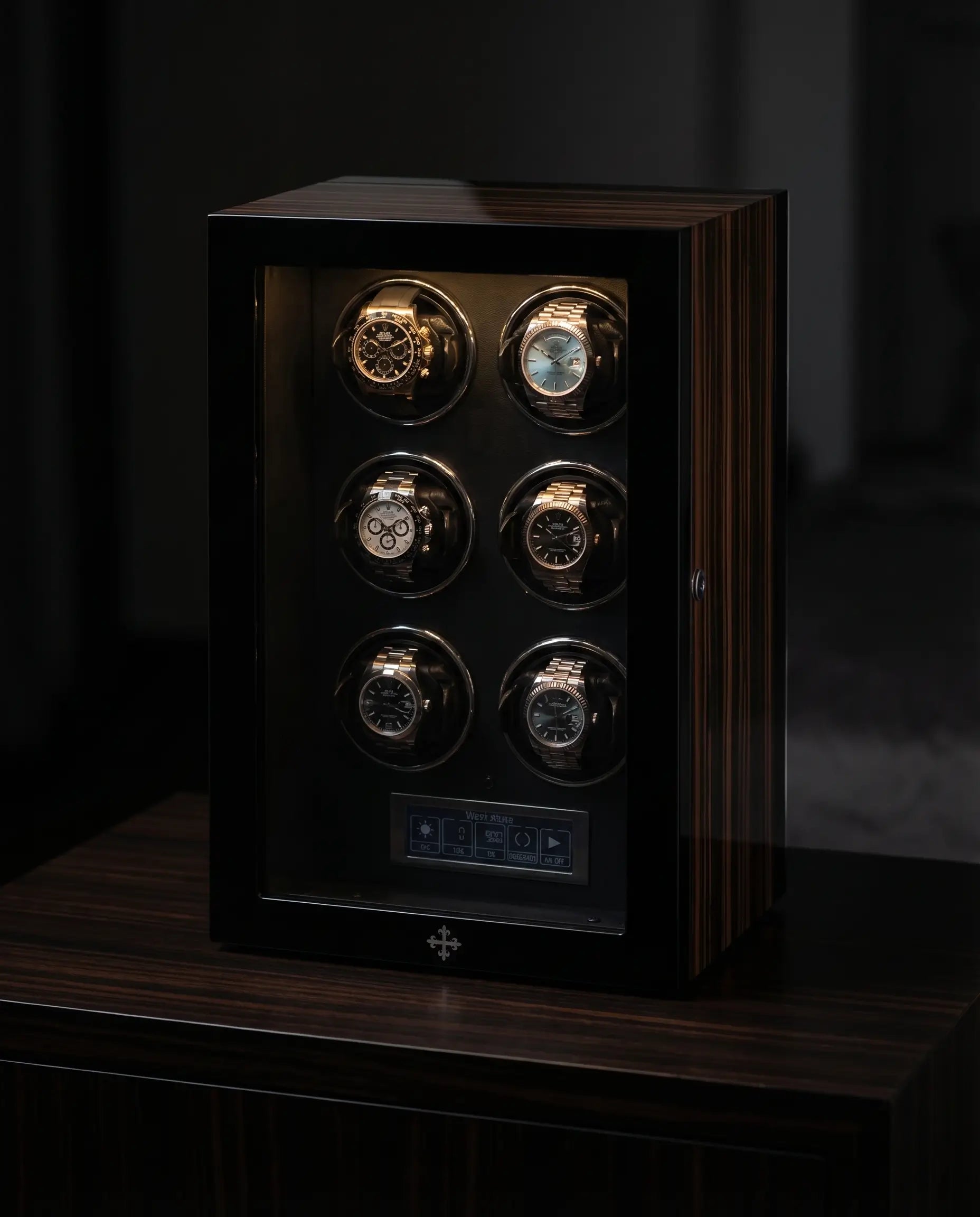
The watch winder turns. In the background, in the office or on the nightstand. And after a few days, the noise settles in — that continuous hum that eventually becomes a presence. This is not inevi...
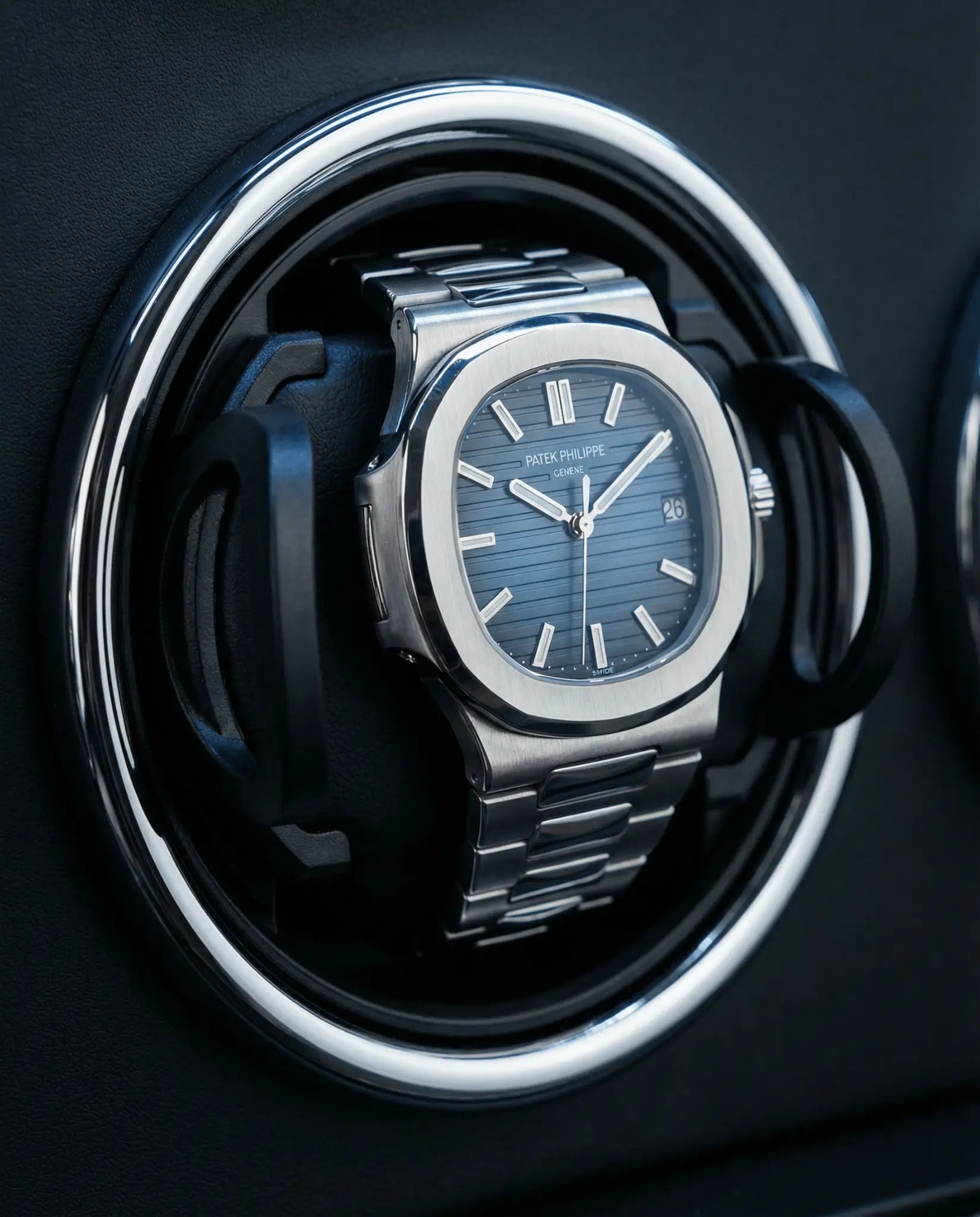
Choosing an automatic watch winder is a technical decision before it is an aesthetic one. A good winder preserves movements for years without intervention. A poor winder imposes repeated stops, lab...
Leave a comment
All comments are moderated before being published.
This site is protected by hCaptcha and the hCaptcha Privacy Policy and Terms of Service apply.